Six
Soul Guardian: A Hellishly Cozy FantasySix, originally Marleene Quinzel and later associated with the name Six Sharoth, is the child at the center of the book’s transformation of an intended sacrifice into a chosen family. Her summoning of Bael-Sharoth begins as an act of practical desperation over a stuck jar, but it brings into the living world a powerful demon who becomes entangled in her safety, identity, and future. Six’s decisive importance lies in the contrast between the role imposed on her by adults and the agency she gradually exercises in deciding whom to trust and what kind of family she will accept.
Identity and Background
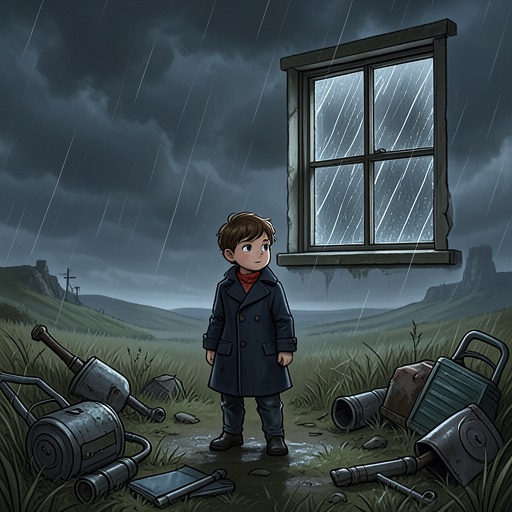
Six’s original name is Marleene Quinzel. At five years old, she became the sole survivor when her father took a turn too fast and sent the family station wagon over the edge of Devil’s Slide. Rescue workers cut her from the wreckage hours later, after an accident that changed her from the youngest of three children into a child with no surviving family. She spent months recovering alone in a hospital and then two years moving through the foster care system.
That history makes Six’s later suspicion of guardians more than ordinary childhood caution. She had not merely lost a home; she had repeatedly been placed under the authority of adults whose promises could not be assumed to mean safety. Her movement through foster families established abandonment and institutional uncertainty as the conditions from which her later relationships emerged.
The Cult and the Summoning
Six eventually came into the care of Mike, a charismatic cult leader. His motives were never genuinely parental. From the beginning, he intended to sacrifice her to any demon willing to answer the cult’s ritual, and he replaced her given name with the more useful sacrificial designation Six because no self-respecting demon would accept a little girl named Marleene.
The cult’s plan also reveals how precarious Six’s position was within the ritual. Its members had tried repeatedly without managing to summon even an imp. Bael-Sharoth arrived through what the narrative treats as an accidental success, but the result destroyed the cultists’ presumed control: instead of securing a compliant supernatural recipient for their sacrifice, they summoned a being whose presence turned the ritual against them. The cultists were ultimately left encased in twenty-four-karat gold, while Six remained alive to confront the consequences.
Bael-Sharoth first encounters Six in a stone room surrounded by eleven golden statues and confined within a precisely replicated rune circle. When he tries to leave, the barrier strikes him with overwhelming arcane force, making the supposed summoner’s prison into a genuine containment device. Six identifies him without ceremony and introduces herself, then asks him to open a jar whose lid is stuck tightly. The request is deliberately mundane beside the ritual’s impossible scale. It also establishes Six’s characteristic position in the story: she can stand at the center of demonic power while remaining focused on an immediate household problem.
Trust, Questions, and Agency
Six is not naturally trusting. Her foster father Mike attempted to sacrifice her to the first demon who appeared, and the adults around her continue to surround her with dangers she cannot initially understand. When she learns that her new foster father is supposedly going to initiate the apocalypse, the pattern becomes so absurd that she wonders whether something is wrong with her. The joke carries a serious consequence: Six has been trained by experience to suspect that guardianship may conceal exploitation.
Her questions therefore function as tests rather than simple requests for information. She must determine whether Bael-Sharoth is another adult using her, whether supernatural promises are safer than human ones, and whether the protection offered by a new household can survive the obligations and conspiracies surrounding it. The narrative repeatedly places her practical intelligence against the grand language of prophecy and catastrophe. A child who has already been treated as an expendable object refuses to accept the roles assigned by cultists, foster systems, or apocalyptic plans without examination.
Adoption and Chosen Family
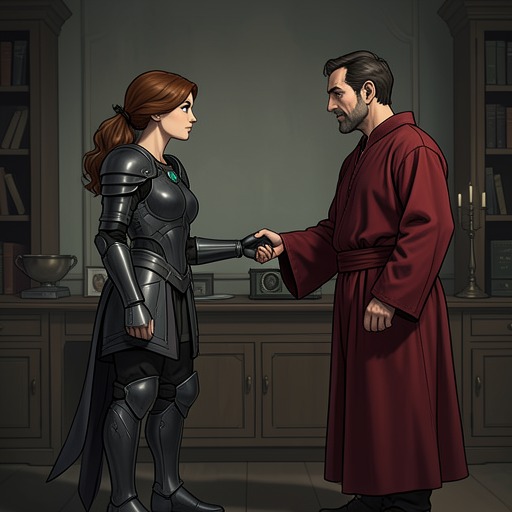
The story later moves from provisional protection toward a formal commitment. During a night out, while lasagna cools in the kitchen, Bael-Sharoth retrieves the adoption papers rather than waiting until after dinner to give Six the good news. Both guardians have already signed their portions, but the papers require one additional signature before they become valid. The legal document converts an improvised household into a recognized family arrangement, making explicit what the earlier rescue and day-to-day care had begun to establish.
This moment matters because Six’s central conflict is not simply whether she will survive. It is whether survival can become belonging. The cult gave her a replacement name in order to make her easier to kill; adoption offers a name and place within a relationship intended to preserve her. The contrast does not erase her history, but it changes the meaning of the same basic fact: adults are once again defining her status, yet this time the process is directed toward protection and permanence rather than sacrifice.
Narrative Role and Significance
Six serves as the human measure of a world otherwise dominated by demons, fallen angels, cosmic threats, and bureaucratic supernatural power. Her presence exposes the moral difference between possession, custody, sacrifice, and care. The book’s broad conflicts repeatedly return to the question of who controls a vulnerable person, while Six’s survival keeps that question from becoming abstract.
Her trajectory combines rescue and maturation, but with an important reversal of the conventional heroic pattern. She is summoned into danger rather than leaving an ordinary world by choice, and the apparent monster summoned to consume her becomes part of the protection she needs. The ritual that should have ended her life instead initiates a chain of relationships through which she can ask questions, challenge authority, and receive a family not because blood or prophecy guarantees it, but because people choose to remain responsible for her. Six’s significance consequently lies in the story’s refusal to let apocalypse overshadow the child who must live through its consequences.